Saturday, October 30, 2010

Pictures of Food in Soilutions' Dirt

I am always encouraging people to send me pictures of their projects to post here. Surprisingly, I get very few. Here are a couple of photographs of some food grown by a Soilutions customer in our Topsoil Blend.

The lovely Artichoke. I don't know why it isn't grown more often in this climate. It handles the weather well and is so beautiful.


My personal favorite: Chard. It is so versatile in the kitchen, it is so easy to grow, and it too is lovely.


Who doesn't like watermelons?

Thursday, October 14, 2010

Former Employee Makes Good

Here's a shout out to a former employee of Soilutions: Casey MacFarland. If it weren't for Casey's leaving, I would never have had the opportunity to work here. But he moved on to do what he loves and now he has a book out.

Check out his website: http://wildlifetrackingsouthwest.com/home and see if you can't attend one of his book signings near you. There's one this Sunday in the East Mountains.

Tuesday, October 12, 2010

Seed Saving Workshop

Please Join Us!!

Seed Saving Workshop
with Joshua Cravens director of the Arid Crop Seed Cache
Saturday October 16th, 2010
3:00 PM
Free
410 Atrisco NW Albuquerque, NM 87105
Just north of Central


This is our last workshop of the season. We will cover seed saving basics, with lots of hands on examples as well as more advanced techniques such as saving seed from biennials.
• Why Save Seed
• How to Save, Clean and Store Seed
• Saving Seed from Biennials


Biennial plants are ones that go to seed during their second growing season, usually in the spring. Some example of biennial plants are parsnips, carrots, cole plants (cabbage, brussel sprouts, turnips, kale and so on), celery and celery root (celeriac), parsley, beets and swiss chard. Come learn tips on how to best save seeds from your biennials.

Hope to see you there!!

Questions, please email Sarah:
sarah@gardensedge.org
505-948-8398

Friday, September 17, 2010

Lots to do this weekend

There is so much to do this weekend. I figured instead of enumerating it all, I'd send you to a great website, hosted by a great organization, featuring a great calendar. Soilutions will be at a couple of these events.

http://www.gardenersguild.org/urbangardenactivities

While you're visiting the site, go ahead and become a member.

Get out there and garden!

Thursday, September 02, 2010

Weeds

By a VERY informal poll, all of you are sick and tired of pulling weeds for past three months. The rain is great but I know that, in the far reaches of my brain, I curse ever so slightly the rain because of all the inevitable weed sprouts.

I have been trying for years to document the power of mulch in terms of weed control. I have 5" or more of mulch throughout my property. Where the mulch is undisturbed, I have zero weeds; where the mulch is mixed with soil, the weeds have taken hold, but are really easy to pull because the roots are in the friable mulch; where there is no mulch, the weeds are strong and impossible to pull from the compacted soil. It really is significant enough to warrant consideration, but I weed in the morning before the sun rises so photos don't really come out well.

In the course of conversation with customers, I finally got one long time customer to send me a picture of her garden.


This picture is an excellent example of what a layer of organics can do to ease weed ills. Obviously, on the left of the path, no treatment. But on the right, she says "On the right, I mulched as follows 3-years prior to this photo: 1-2 layers of cardboard + 1" of Soilutions compost + 2" of Soilutions wood chips."

At home, I have started using the weeds as an organic layer, i.e., instead of cardboard. So I pull the weeds, lay them flat, cover them with mulch. That way I save room in my truck for the bulkier branches.


Pretty convincing. Thanks for the photo.

Thursday, August 19, 2010

Portable Gardens

I love to garden. Duh.

But I would also like to live on a boat and sail around the world. Or maybe just drive around the country tasting vanilla ice cream from all the small creameries on all the small roads in all the back woods of our world.

Or I would love to live in a very hip city, Paris of course, or Portland (Maine or Oregon), Sofia Bulgaria, on the tip top of a high rise.

So, my living fantasies don't really have space for a garden, it seems, even though I would give up many, many comforts to continue to be able to taste a carrot 10 seconds out of the ground.

I followed a blog by Roz Savage as she was rowing solo across the Pacific Ocean. Enthralled, I bought her book depicting her similar journey across the Atlantic. As a composter, I kept asking myself, does she have worms on board to manage her waste? She didn't as far as I could tell, but it turns out she kept a pan of bean sprouts growing for her fresh food supply.

There was a customer a year or two back that worked in a women's health clinic. She and her fellow workers were finding that many of her patient's illnesses were related to poor diet. So she commandeered half the facility's parking lot and built a garden to help instruct women how to eat.

Gardening helps me stay active. My neighbors are well into their 60's and can work me under the table still. I attribute that stamina to daily work in their garden. But when I am old and in a retirement home or should one of my fantasies come true and find myself living atop a building in Bucharest, how am I to maintain a stress-busting garden?

So, from the scientific testing laboratories of Soilutions, Inc, comes a new gardening tool: the portable garden.


Light enough to move, small enough to fit on a roof top or in the back of pickup, yet filled with the same great growing medium you have come to know and trust from Soilutions.

I am speaking of a mesh "sock" filled with a blend of compost, soil, and composted chips. Simply lay out the sock, slit it, plant starts or seeds, water and viola!

Landlord kicking you out just before tomatoes are ripe? A portable garden will allow you to take the tomatoes with you. Too much asphalt? Not enough space? Guerrilla alley garden? Traveler? This might just be the answer to your problems.

Saturday, July 31, 2010

Organic Pest Control

Here are a couple of pictures of little guys doing overtime to keep the flies down around here.


Thursday, July 29, 2010

Cover Crop Conversation Continued

A question was raised concerning the previous blog entry/email.

I have a question on the cocktail mix. It's my understanding that most cover crops are harvest/cut/flailed, etc.
sometime between the start of flowering and halfway into bloom. With a cocktail, how do you determine the optimum time to take the cover crop down? Is it the flowering schedule of the earliest member of the mix?
The average point of all of them?


And the answer:

Most of our farmers terminate the cover crop with winter kill, meaning it is allowed to fully develop. Before moving into soil health we terminated all sunlight harvest after grain harvest. Now we use the cover crops to harvest the sunlight from grain harvest to winter. This sunlight ultimately becomes additional carbon in the soil. Making increases in soil organic matter more achievable. We have built soil health based no-till systems on the cropland and grazing systems on the rangeland, then the cover crops are used as a bridge to connect the cropland and rangeland. We try for a continual live root, just like native rangeland has. The livestock are a tool to harvest 40-50% of the cover crop biomass, leaving the remainder as soil armor. The livestock can also be used to terminate cover crops by mob grazing. I have attached pictures showing what the soil cover looks like before


and after


having 750,000 lbs of beef per acre graze a cool season cover crop cocktail. Our local Soil Conservation District also has a crop roller which is used to terminate rye or field pea.


We rolled the pea during bloom and the rye during 50%+ anthesis, both were seeded as monocultures. Occasionally we have farmers who terminate a cover crop mixture with herbicide, but only rarely with tillage.

Cover Crops

The following is excerpts from an email conversation concerning cover crops for a local organic farm. I am finding it very useful as this particular aspect of sustainable farming is difficult for me to understand.

Your first attempt at planning a cover crop mixture is very good. As I recall some of the resource concerns included armor (surface residue), crop diversity, soil aggregates, nutrient cycling, and infiltration to name a few. I see the mixture consists of cool season broadleaves and cool season grass, which is what we would use here for a fall seeding after harvest. The high carbon portion appears a little high, with the first 4 species making up 50%, while the legume may be a little low at 30% of the mix. I would suggest decreasing the high carbon to 40% and increasing the legume to 40%. Possibly an additional legume could be added, such as Lentil. The brassica portion at 20% looks good, since they are nitrogen scavenging and low carbon you do not need very much. The high carbon will give you soil armor and their roots will improve the soil aggregates and soil organic matter. The legumes will improve the nutrient cycling, while the brassicas create streets and avenues for the water to move into the soil profile. Improving soil health is about restoring balance, and the cover crop mixtures will help you with this task. Always try to include crop types in the cover crop mixture that are not used in the annual crop rotation, this will improve crop diversity and help feed the soil biology a more balanced diet.

I attached two cover crop pictures too.


[The photo above depicts] a 14-way mixture, which is primarily cool season. It was seeded at the Menoken Farm on May 12 and includes: wheat, oat, forage pea, lentil, ac greenfix, turnip, radish, sunflower, Italian rye grass, hairy vetch, sweet clover, phacelia, canola, and flax. The native pollinators did very well with this mixture too.


[This photo is] a primarily warm season 11-way mixture, and was seeded on June 14th at the Black Leg Ranch. It consists of: pearl millet, proso millet, sudan, soybean, cowpea, sunflower, radish, turnip, sweet clover, canola, and corn. Both are based on the clients resource concerns and objectives. This is not the first time that nature has seen this many different plants together. We have to understand they are working together and not competing. Thank you for your interest in soil health.


I have used this email without permission from it's author but thank him nonetheless.

Friday, July 16, 2010

Hot enough for ya?

The weather has been nice lately; I especially enjoy the cool overcast mornings. But I bet your plants are suffering. We have received about 1" less than average of rain so far and have had two (at least)spells of intense heat. For those of you without a swimming pool, it can be tough to cool down. Next time you are sitting inside with a cold beer while watching Buffy reruns, think of your poor plants wilting in the afternoon swelter. Vegetables won't set fruit when it gets over 90F. Heat stressed plants are more susceptible to disease and pest damage. But when you continue to dump water on them, your water bill will punish you.

You know where this going...

You need to mulch. Mulches, like compost, are a universal cure all. A thick layer of organic mulch keeps soil temperatures low. It helps retain moisture in the soil. (Did you know that in New Mexico, we have the evaporative average of 60" annually? That means that in New Mexico, the natural evaporation of water from soil to the atmosphere averages 5 feet a year. 5 feet! We only get 8" or so of rain to replenish that.) That moist soil provides a habitat for beneficial organism that create a healthy growing environment for plants. It's not by accident that bushes and trees drop their leaves periodically; they are providing mulch to protect and build the soil in which they live.

Although visually pleasing mulch is in some cases as important as properly functioning mulch, some materials perform better than others in some situations.

Windy areas: we have seen over the years that particle shape is as important as particle size when choosing a mulch for a windy area. An elongated shape tends to allow the mulch to knit together so that it stays in place better. These mulches also do well in well traveled areas.

A coarsely ground woody material is a good example. We call this Native Mulch


Another good example is this material. It is a little more decorative. We call it Black and Tan.


Established Trees and Shrubs: The problem with amending the soil around established trees and shrubs is that an disturbance of the soil will damage valuable feeder roots. So a mulch that contains a lot of humic acid containing compost will perform two functions: feed and protect the soil.


Forest Floor Mulch is an excellent mulch for established trees.


Decorative areas: Sometimes you want to show off a rose garden or create a pathway. A good mulch for that application would be a uniform material. These are generally processed more and will be a bit more expensive. Pecan Shells or Wood Mulch are excellent materials.

A new mulch we have is a good pathway mulch. It is a certified playgound mulch called Playsoft.

It's light in color, very uniform in particle distribution, attractive and soft.

Vegetable areas: Now here is where it gets fun. I like to use short fibered mulched in the veggie garden because they generally break down faster. Short fibered materials are usually not as carbonaceous so they won't rob nitrogen from you prized tomatoes. The best part (to me at least) is that these potential mulches are everywhere for the taking. Grass clippings or leaves make great mulches for veggie gardens. Of course, an excellent mulch for your veggies is a compost approved for use on certified organic farms...Premium Compost.

Friday, July 02, 2010

Vote for a Charity

This was forwarded to me by an old friend.

http://today.msnbc.msn.com/id/38027143/ns/today-what_do_you_care_about_today/

What warrants a blog entry this time was the dilemma between the organizations from which to choose. The old school in me says that surfing always trumps anything else. There really is a cleansing quality to the surf that every one should test. But the new school in me sees a huge demand for urban farms. My recent experience with our Soilutions' sign painting makes me want to vote for the urban art project.

So, I leave it up to you all to vote your heart. I don't think there is a bad choose.

Friday, June 25, 2010

Los Poblanos Lavender Festival

Make arrangements to attend this year's Lavender Festival at Los Poblanos Organic Farm. More information at

http://www.lospoblanos.com/lavender_farm/-/lavenderfestival/#

This year, Ski has been working really hard to organize foodwaste collection at the festival. Special events pose specific hurdles when it comes to organic waste collection. The general public is notoriously unreliable at separating organics from non-organics. This year, as I understand it, there will be a slew of volunteers to stand by the collection carts to help festival attendees properly sort all recyclables, not just the organics.

So when you go, thank the volunteers and pay special attention to the green carts marked "Organics Only" and know that you are helping us reduce local greenhouse gases.

Not to be outdone, Soilutions' owners Jim and Karen Brooks will be offering a composting workshop for the event. If you've never seen them speak, you will be in for a treat; be prepared to leave energized about your home compost.

Friday, June 18, 2010

Seedlings Up For Grabs

So a long time customer just came in with several flats of Tomato starts. There are about 200? They were grown by an organization called seed2need out of Corrales. As I understand it, they grow food on vacant and abandoned lots and donate the food to the food bank system. They grew way too many seedlings this year, so want to share their wealth a little. They only ask that you follow in their footsteps and give some of the tomatoes to the food banks. The Storehouse on Broadway was suggested but there are several. Our customer works at RoadRunner Food Bank, so there is another one to consider.

Wednesday, June 16, 2010

Vermicompost for Sale


Every six months or so, we clean up our worm beds. When the beds contain more castings than fresh food for the worms, it becomes toxic to the worms. They become lethargic, get smaller and, if left alone, will die. So we dig the worm castings out and replenish the feed stocks. This year I used a combination of leaves and grass clippings. After I dug out the bin, I passed the material over a 1/4" screen to get most of the worms out and to separate any large or uncomposted material from the fine particle sized casting. The worms and the larger pieces go back into the bin while the finer material goes into the garden. Or if you want, it can go into YOUR garden. We have a limited amount until this fall, so get it now. One cubic foot bags sell for $10. bring your own 5 gal bucket and save $3.


Hope to see you soon.

Friday, June 11, 2010

Rubber Necking

Everyone likes a good fire.


I don't think that the building has been vacant for years and is now for sale has anything to do with it.


I mentioned this property in a post dated July 2nd 2009.. As I recall, I was complaining that it was properties like this that got me depressed sometimes. It didn't occur to me that burning the place was a viable solution. Maybe I was wrong.


As I write this, our delivery truck is detained at the top of Bates Rd. Something about a hazard. I wonder if they are going to evacuate us?

Then it got really big.

Thursday, June 10, 2010

The New Face of Soilutions, part 2

For a look at what it takes to re-do a "simple" sign, go to: http://www.actualcreative.com/presentations/soilutions/


The original sign was a "Bates Lumber" sign (we are situated on the same property as the old Bates Lumber Mill), so the structure itself is probably 30-40 years old. You know us: re-use when ever possible.

The first question I had for Danny was how quickly it would get "tagged" by the local graffiti-ists. He said that the culture among the artists prohibited covering up or tagging a well-done mural: honor among thieves so to speak.

I suppose that last comment is unfair, at least to Danny. Here in Albuquerque, spray paint is considered a blight to communities performed by thugs and deadbeats. Obviously, to others outside our area, i.e., New york City, it is an art performed by artists.

Once again, I am enlightened by a customer.

Wednesday, June 09, 2010

The New Face of Soilutions

Hopefully, you all will see this for yourself. It's the sign at the end of Bates Rd.


We are pretty good at what we do, i.e., make compost. We are not very good at advertising. So when this guy walked into our office and said that he wanted to re-paint our sign, we said okay. We had been thinking of re-doing it for some time; each morning the rust spots bothered us. And now that the RailRunner comes by several times each day, we figured an old rusty sign wasn't the best face for our business.

I encourage you all to check out the guy's website (http://www.actualcreative.com), but in the meantime, here's what I know of him. His name is Danny Skinz and he owns and operates an advertising business in New York City: big clients like Chrysler, Tampico, Nintendo, Ecko, and now Soilutions. Then he had an epiphany, and moved to NM after studying Permaculture. I don't know how he found us (how does anyone find us?) but decided that he could help us out.

His real love is aerosol, i.e. spray paint, and what he really wants to do is paint our delivery trucks. Any one who knows us knows that we don't make quick decisions. So we agreed to have him re-work the sign as a test run. Not a test run for him as much as a test run for us to see if the "urban" style would work for us.

Well, we are as tickled with it as anyone could be. I think it is sharp, unique, and speaks to the growing crossover market of agricultural and urban gardening in which we find ourselves deep in the midst . As one customer said yesterday, "it puts you into the twentieth century finally."

So please let us know what you think as you drive by on your way to recycle those branches, or to buy mulch for your newly planted trees. And look for Ski in our soon to be freshly painted delivery truck at a restaurant or cafe near you .

Thursday, May 27, 2010

Plants for Sale

I have some plants for sale. They are in 4" pots and some 1 gal. containers.

Cosmos are a standard in any garden. These are a variety of colors. Full sun and moderate water. Check out http://aggie-horticulture.tamu.edu/archives/parsons/flowers/cosmos/cosmos.html for more information.


Russian Sage. This is a beautiful shrub but it must be kept under control. Once established, it needs no water. Plant it in direct sun and in poor soil. Check out http://www.americanmeadows.com/Perennials/OtherPerennials/perovskia-little-spire.aspx for more information.


Bee Balm is a very hardy herb with many uses. Check out http://www.altnature.com/gallery/beebalm.htm for more information. The 4" plants will grow and produce bee-loving blooms all summer.


Prices: 4" pots $2.50 each
1 gal. $5.00 each

I have many more. Please feel free to ask me what all is available.

Wednesday, May 26, 2010

Gulf Oil Spill

I wonder if they could use compost in those booms? It's biologically active, loves carbon, won't harm the environment like dispersant.

Here's a blog from San Francisco concerning the gulf coast catastrophe:
http://sfbaykeeper.blogspot.com/

This is big folks. Let's not be complacent.

Tuesday, May 11, 2010

Fun with Recycling part 4

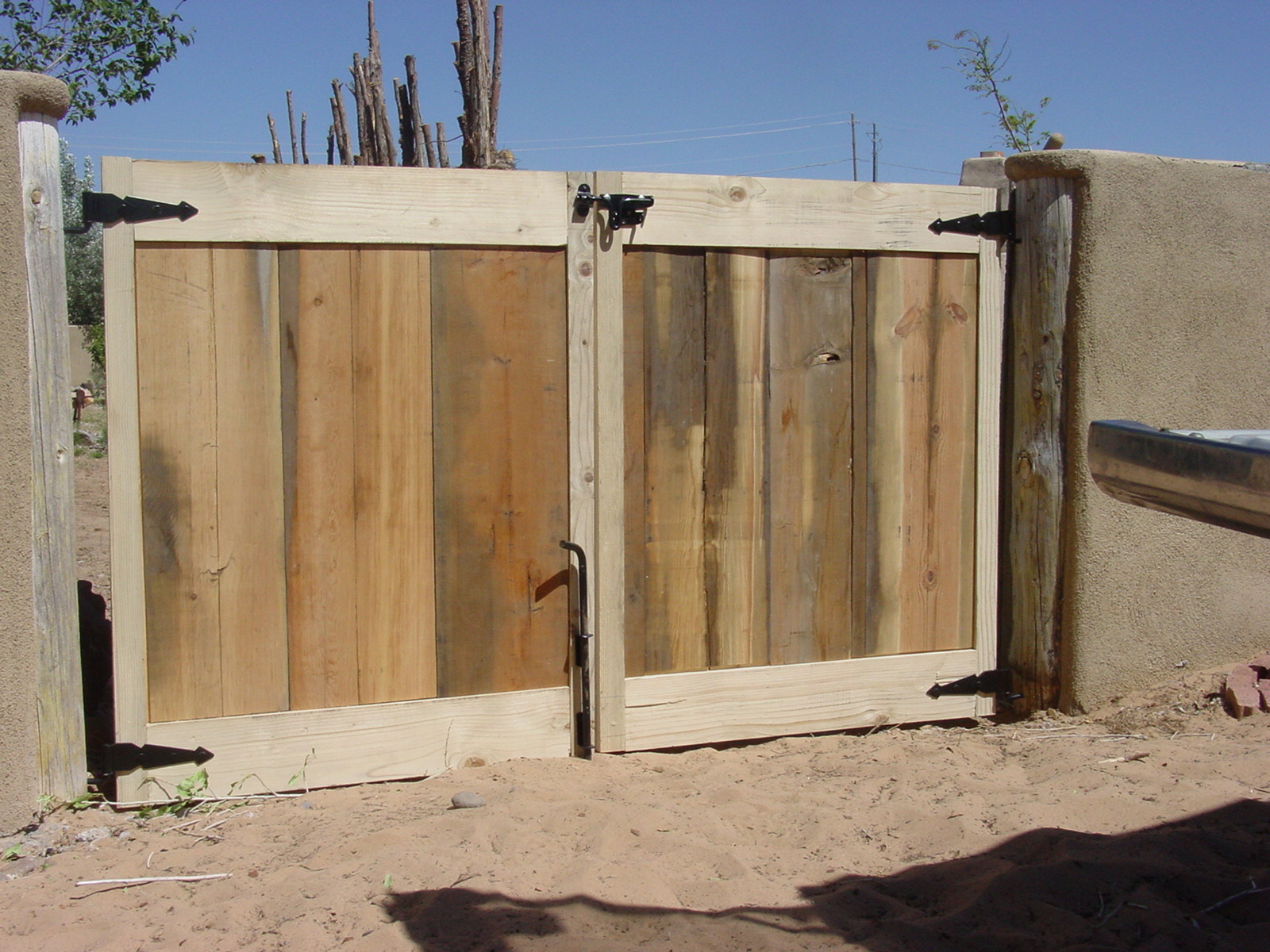
Here are some new examples of what can be done with recycled lumber.


This is a custom "dutch" double gate made to fit a newly constructed block wall. The tops open to let the sunset in while keeping the dogs in the courtyard.


This is a much simpler gate. The problem here was installation.

Both gates are made with Douglas fir scrap lumber using mortise and tenon techniques.