Showing posts with label compost. Show all posts

Thursday, January 06, 2011

New Worm Bin

I know I am a compost dork. I had a real reminder of that this last week.

I am moving into a new apartment. What do you think I set up first? The shower curtain? The computer table? No. I saw that I needed a recycling center first. Moving generates a lot of trash, or I should say it generates a lot of unwanted discards: paper from unpacking, cardboard from the new coffee maker, coffee filter, the paperboard six pack holder, orange peels, etc.

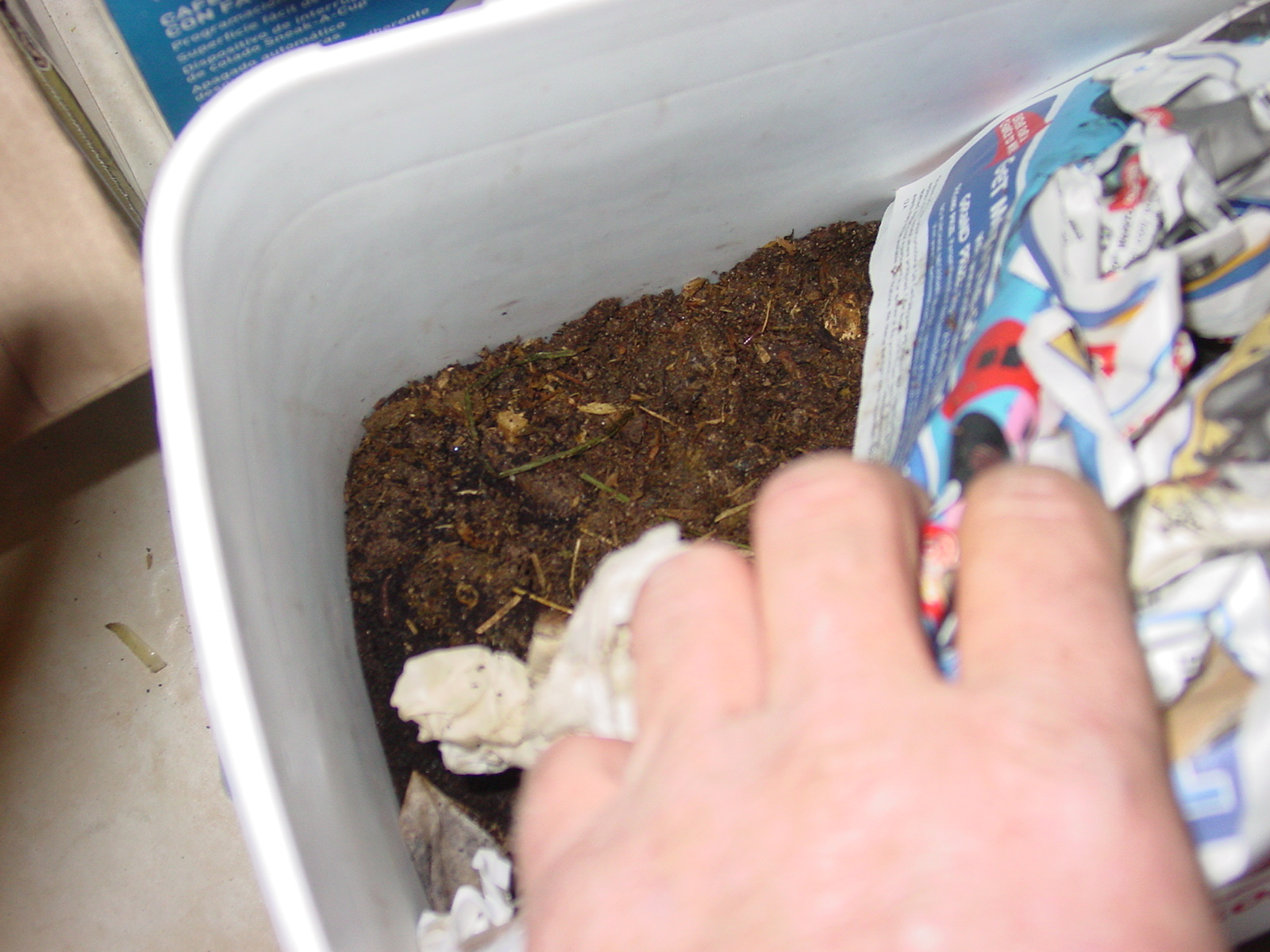
Here is a picture of my simple worm bin.


It's just a 5 gal. bucket with some worms and bedding at the bottom and various organic discards thrown on top. As it dries out, I pour undrunk coffee (a rarity I can assure you), and used dish water. The bulky cardboard I hope will be compressed as more material gets dumped on top.


As you can see, nothing fancy, but it erases the constant chagrin I have when faced with throwing away perfectly good waste.

Moving is usually a time of reflection. A chance to change things that I've always wanted to change but couldn't find the time to do so. I have a long road ahead to make an environmentally healthy living area out of my new small apartment, but at least I got the important thing out of the way.

Wednesday, May 26, 2010

Gulf Oil Spill

I wonder if they could use compost in those booms? It's biologically active, loves carbon, won't harm the environment like dispersant.

Here's a blog from San Francisco concerning the gulf coast catastrophe:
http://sfbaykeeper.blogspot.com/

This is big folks. Let's not be complacent.

Thursday, April 29, 2010

April is the Cruelest Month

"In the very essence of poetry there is something indecent
a thing is brought forth which we didn't know we had in us."
---Czeslaw Milosz, Ars Poetica

It is said that gardening is an exercise in faith. We plant seed, water, weed, on the belief that a miracle will happen. And when it does, we experience the elation of life both externally with having aided the seeds' growth, and internally when we realize that there are things greater than we are. As the seed grows toward the sun, we, too, grow.

Whitman writes:


Now I am terrified at the Earth! it is that calm and patient,
It grows such sweet things out of such corruptions,
It turns harmless and stainless on its axis, with such endless successions of
diseas’d
corpses,
It distils such exquisite winds out of such infused fetor,
It renews with such unwitting looks, its prodigal, annual, sumptuous crops,
It gives such divine materials to men, and accepts such leavings from them at last.

--Excerpt from This Compost by Walt Whitman

April is indeed a cruel time. It offers so much hope that will be dashed by October. But it is a kind month too, offering fruitfulness from last year's "fetors".

Thursday, February 11, 2010

Cold Frame Update--February

Here are a couple of pictures of the cold frame. I've been eating greens for a month now.


Not much work involved. I water once a week if it so needed.

Tuesday, February 09, 2010

Erosion of Our Most Precious Natural Resource

As the spring planting season approaches, many of us will be turning our attention to the vegetable plot out back. Whether you were successful last year or had problems, maybe you’re an old hand at it, or sick of leathery lettuce from the big box markets and have decided to grow your own; I encourage you to first consider your soil.

New Mexico has plenty of dirt, but not as much soil. In fact, NM has the largest rate of soil loss in the nation (USDA http://www.usda.gov/wps/portal/usdahome). The biggest factor in soil degradation is the loss of native vegetation and soil disturbance. Soil erosion puts sediment into our waterways, pollutes our air, adds to our soil reclamation costs, depletes native vegetation, and destroys infrastructure. Furthermore, soil can carry with it chemical pollutants. On a large scale, this is devastating to our rivers, and costs taxpayers, the home construction industry, local, state, and federal governments millions of dollars each year.

In your own landscape, erosion will decrease the value of your property, increase water usage, and decrease plant productivity and longevity. Soil is essential to the health of our planet, our farms, our plants, and our health. Most of everything we use on a daily basis comes from fertile soil: food, clothes, medicine, and home building materials.


What’s the difference between soil and dirt? Look under your finger nails. If there is a brown line under your nails, that’s dirt. If the brown line under your nails has something growing out of it, that’s soil. If you are one of those with something growing out from your nails, consider yourself lucky. In a natural healthy environment, soil consists of inorganic particles (defined by particle size as sand, silt, clay), and organic matter. The organic matter comes from decomposing plant and animal debris (both macro and micro). Organic matter shades the topsoil and protects it from the erosive properties of the wind and rain. It also provides a habitat for the micro-organisms that improve the moisture retention and nutrient availability of the soil. While most NM soils have an adequate percentage of inorganic particles, they generally lack sufficient organic content. (For a good look at soil components’ total volume percentage, see Permaculture: A Designer’s Manual by Bill Mollison, pg 200.)

This insufficiency in organic content often leads to over-use of synthetic fertilizers and pesticides. The use of synthetic fertilizers is intended to artificially stimulate a plant, similar to steroid use in humans. The more holistic way to treat deficiencies is to treat the cause, not the symptom. The reason a plant performs poorly can in most cases be traced back to the soil in which it grows. A healthy soil makes healthy plants. Studies have recently shown that fruit grown with synthetic fertilizers have less nutrition than fruit from plants grown in healthy soil. Fortunately, we see throughout the growing regions of NM many farmers succeeding by carefully minding the health of their soil.

While you may not be farming an acre of heirlooms for sale at the markets, each of us can do more on a local level, to heal the life blood of the planet. That barren hard pack may not be as useless as you imagine. The single most important thing an individual can do to remediate soil and prevent erosion is to mulch. Properly installed organic mulch does so much: reduces evaporation, cools the soil, filter storm run-off, controls weeds, and establishes the microbial environment necessary to provide the slow release of nutrients. Organic mulch protects the bare soil from the erosive properties of wind and rain by providing an environment where plant roots can form a binding matrix.

Another easy and effective way to quickly remediate soil is to add compost. Where mulching is a slow method of tending to you soil, adding compost is an immediate boost in beneficial microbe population and replenishes valuable nutrients absorbed by plants throughout the previous growing season. Making compost also diverts methane producing organic matter from the landfills. It is easy to make at home and benefits all kinds of soil types.

Now that less than 5% of the US population live in rural settings anymore, we don’t think of the role of soil in our lives except when the kids track it in. When farming was a way of life, taking care of the soil was an obvious and important element of that way of life. We have lost a connection to the soil. “To forget how to dig the earth and to tend the soil is to forget ourselves”. (Mohandas K. Gandhi) As a country, we need to regard the soil as a living organism, and to nurture its health. Time is running out. Although the human species is not yet endangered, out fate is inextricably intertwined with that of all other species.

Thursday, December 24, 2009

Poem

Winter, and Christmas time in particular, brings out the sentimentalist in me. So here's a poem I wrote the other day to celebrate the tenacity of nature.

-----

This Tuesday morning is as cold as Monday
Swept up in a drift of three days uninhabited
The smell of a barn long vacated

I swing around the corner in a white Ford
Looking for signs of weekend hooliganism
None to see, just piles of leaves

Piles of leaves shaped like a mini Kilimanjaro
Her head amid gusty clouds
Except here its restless leaves rustling

And I stop to reconnect with the first heap
Not the most important heap we have
Just the first one I see on this Tuesday morning

To see if it’s steaming, water vapor rather,
To see if it’s vaporing away like it should
Like it did yesterday morning

It is my rock, my one true thing, my Kilimanjaro
This first pile of compost I see
Decomposing because I came to work, once

Regardless of how my weekend went

-----

Happy Holiday.
Be safe.
Make Compost

Wednesday, December 23, 2009

How to figure a good carbon: nitrogen ratio

Here's a good site to help determine a good ratio for backyard composting.

http://www.mastercomposter.com/ref/calcc_n.html

Friday, September 11, 2009

Master Composter Classes Now Available

Through the hard work and perseverance of John Zarola, Albuquerque will be able to offer Master Composter classes in the spring. The classes will be designed to "teach the teachers." This means that interested individuals will be able learn all about small scale backyard composting in such a way that they will then go out into their community, i.e., neighborhood associations, schools, senior centers, and instruct others.

The training classes, for approximately 20 students, are projected to be held on:

April 24, 25 and May 1, 2 of 2010. Classes will run from 9 AM - 3 PM on all 4 days.

Class location will be: the Open Space Visitors Center, 6500 Coors Blvd., NW, ABQ, 87103.

Jim Brooks (of Soilutions fame) and other professionals will instruct the students according to the stated curriculum. Field trips will be added to the training requirements as planning evolves.

Students accepted into the program will agree to a certain number of volunteer hours which will be completed after graduation by teaching the interested public about home composting.

The current active steering committee is composed of: Jim Brooks, DeLaina Cushing, Dorothy Koopmans, Joran Viers and John Zarola.

After construction of an informational website, continued information, including: curriculum, references, application form, text book and assignments will be available at:

www.bernalilloextension.nmsu.edu/mastercomposter. Notice will be sent when this site is active.

Currently questions of interest may be sent to: John Zarola, Volunteer Coordinator johnzarola@comcast.net.
505.929.0414

Wednesday, August 26, 2009

Permitting Influx

Today, on the way to work, the tule fog was back after several months on hiatus. The cooler weather and moist air even brought a mist over the swimming pool. It evoked a change, in seasons to be sure, but I couldn't help thinking a change in something grander, too.

Not to be overly dramatic, but the change is here. In the last week alone, Soilutions and it's neighbors have been inspected and in some cases fined by: NM Environment Department Ground Water Quality, NMED Hazardous Waste, OSHA, Bernalillo County Fire Department, and the EPA. The way things feel, I am sure the City Dust Abatement Department as well as god knows who all else are on their way.

I don't have any complaints about being compliant. It keeps every Tom, Dick, and Harry from getting into the lucrative composting business. There is a certain validness with ground water protection, employee safety, and fire hazards. But what gets me, or rather one of the things that gets me about the whole thing is that they don't offer alternatives, reasons, or, in some cases, legitimate fire prevention practices. You are supposed to do as they say. If you try to correct the violation, but do so incorrectly (because they don't care to offer any insight into what they mean by "approved" containment, for example,) no credit for trying. In fact, it appears that a failed attempt will get you a fine.

Soilutions has been in operation for over 13 years. Within that time, we have NEVER had a work related injury, NEVER had a fire, have ALWAYS had a certified facility operator on staff. We have NEVER had a customer accident, injury or even an unpleasant experience (well, I shouldn't say never an unpleasant experience. More like overwhelmingly favorable). We are kind, courteous, respectful, and helpful. We play by the rules and expect others to do so as well. When we opened shop, we asked the Bernalillo County Fire Department for an inspection. They did not come for 12 years! When they did finally show up early this year, the fire marshall finished the inspection by handing over a $70 bill to pay for it. I thought that's what taxes paid for!

And the inanity of it all. Because a neighbor had a fire along the ditch bank caused by a burning butt tossed by a passerby, we have to take temperature readings every week. We don't have to file those temperatures with any one at any time, but they do need to be available for review at the whim of the FD. Why? Anyone who knows about combustion, should know that the biological process inside a compost pile is vastly different than the combustion of a carbon source. But the point is, how does temperature readings deter fire hazard in the first place? If my pile is going to spontaneously combust, won't it do that regardless of my temperature readings? And, the pile most likely to burn is the pile of brush that will read ambient all the time. I feel like the boys with badges are just trying to boss us around. Granted, not all the departments coming by to inspect our operations have been adversarial. But "to a hammer, everything looks like a nail" and just by having to host these curious eyes we are risking fines that, in all honesty, even the best of compost companies can ill afford to pay.

So I suggest that we "inspect" some departments of our own. I'll start with the Bernalillo County Road Department. If I have to call one more time to have that pile of illegally dumped tires picked up from down the sreet, I'm gonna pick them up myself and dump them on their front steps. And how about the Sherrif's Department patrolling the road in the first place to stop the illegal dumpers; or the bums stealing copper from our yards every other freaking Tuesday afternoon!

Anybody else have a Department they wnat to put on notice?

Friday, June 05, 2009

Call For Photos

I am always curious about the projects on which people use our products. People seem so excited when they leave here; their excitement is contagious.


So, I am making a call out to our customers to send me photos of their projects.


It could be a photo of a bountiful harvest.


Or a favorite plant responding to compost tea


Maybe a photo depicting potentialities.


We love to see projects getting installed, too.


Regardless of the photo, let me know if you want credit for the photos. I look forward to seeing what wonderful and creative things you all are doing.