When I started this blog, I was so looking forward to winter, this time of year in fact, because it would afford time to post regularly. I have a folder of all the ideas I was going to address, and the sheer lack of customers coming in the door would allow me to take each idea and cultivate it into full blooming recantations of life here at the compost site.
Well, it has definitely slowed down, but I find that there is truly not much happening here. I am not getting the daily phone calls of interesting questions. I have built and planted and watered and pruned and harvested almost everything available. So, before my boss reads this and starts wondering why he is still paying me, I will tell you of some on-going projects.
We screen our Topsoil Blend now. After collecting sod that people have judiciously recycled with us throughout the previous year, we blend it with Premium Compost and let nature work her magic for another year. Then, we move our screening plant out to the north ramp and start screening the large particles out. Screening Topsoil Blend is one of those endeavors that has come to signify both the end of the year and a bold statement for us of the hope for the coming year. It offers us a chance to begin our reflection on the year past but also to commit ourselves to the future. It's akin to tilling your garden in the fall.
We will also be working hard on developing a new mulch or two. Without getting into details, things changed rapidly in the landscape manufacture business this year. We see both an opportunity and a necessity to continue to develop and produce from locally recycled materials products that are useful and attractive.
With the seasonal decline in the number of retail customers, I get to get out of the office more. I have meetings with entities involved in the organics industry and I participate in the NM Recycling Coalition's many endeavors. I visit past, current, and prospective customers. I like to thank people who have spent time or money with us. One of the budding relationships about which I am really excited is a project with Gardener's Guild on Central. If you haven't checked them out already, do so.
We strive every day to give our customers a good product at a fair price. We want an educated customer. It is unfortunate that the season I have the most time to spend with curious gardeners is the season when no one is thinking about their gardens. So we spend a lot of time by the heater (and often times on top of a steaming compost pile) dissecting how we do what we do and how better to do it.
I guess there is more to do here than I had originally thought. Stay tuned for updates on the haps.
Wednesday, December 02, 2009


Wednesday, November 25, 2009
Respect the Bird
Respect it!
Don't forget to compost that carcass and all the vegetable scraps that gave so that you might celebrate.
Be save.
Happy Thanksgiving
Don't forget to compost that carcass and all the vegetable scraps that gave so that you might celebrate.
Be save.
Happy Thanksgiving
Friday, November 20, 2009
Electronic Pruning--Part 2
On 8/27/09, I posted an entry about pruning an apple tree. In it, I took pictures of an apple tree I had inherited when I moved into my house oh-so long ago. I wanted some expert advice on how to prune it properly, but didn't want the professional (in this case Corva Rose with Divine Earth) to drive all the way out to my property for just one tree. I also like to do that kind of work so any effort made by Corva would not result in any paying work. That has happened to me many a time, and it just isn't any fun.
Back in September, the tree was fully leaved out and bearing lots of small apples. Now the tree is essentially bare of leaves. I have taken the pictures from the same spots and sent them on to Corva. While I await her response, here is the tree from various angles.
Looking East...

North...

West...

And finally South...

Obviously, the photos should be as clear and descriptive as possible. I'll see what else Corva needs and let you know.
Back in September, the tree was fully leaved out and bearing lots of small apples. Now the tree is essentially bare of leaves. I have taken the pictures from the same spots and sent them on to Corva. While I await her response, here is the tree from various angles.
Looking East...

North...

West...

And finally South...

Obviously, the photos should be as clear and descriptive as possible. I'll see what else Corva needs and let you know.
Wednesday, November 18, 2009
Leaf Mulch
Some of you may know that for years I have run a little landscaping business (yes, I am for hire). Mostly now I just do cleanups and small installations, but I have been known to do major jobs. Obviously, my work is steeped in recycling and compost use. This Monday one of my long time customers asked me: "Can you take these leaves away and bring me some mulch?" I was speechless (but only for a moment).

I explained that the falling leaves were in fact nature's way of providing a mulch.That the leaves contained nutrients and trace minerals that the trees had absorbed all summer from the soil. That if left to blanket the soil around the tree's drip line, they would insulate the soil and roots, then slowly decompose. That that decomposition would then return the nutrients and minerals back to the root zone of the plant for re-use.
She was a little shocked that one didn't need to buy a mulch to effectively protect the soil and roots around a tree. Appearance was an issue so we agreed to leave the leaves in place and cover them with a thinner layer of Pecan Shells. Problem solved, for now.
But I was intrigued by the notion that in order to garden well, one had to spend money. Or more broadly, that landscaping is some process designed and schemed by some entity out there that knows better than nature does. I run into this frequently at Soilutions when people want to: put wood ashes on their NM lawn, blend compost with Peat Moss, use weed barrier, direct rainwater off the property and use sprinklers, grow blueberries in Albuquerque, or put a "dry river bed" from no-where-near a downspout to no-where-near a plant.
I run into this all the time in my own business, as well. I feel that people should take care of there own waste. Basically, if you make a mess, clean it up. In landscape terms, that means, to me , that if you have a lawn, YOU mow it, YOU be responsible for knowing how to care for it, etc. If you have a tree, YOU deal with the leaves when they fall. It's my version of what's "wrong with the world", like over-population, living beyond one's credit means or whatever the catch phrase of the day is. I think a personal responsibility to our immediate environment would engender more sensible landscapes, produce less waste, and create a more diverse and thus more personable urban environment. Obviously though, there are plenty of reasons to hire help for some of your landscape needs.
But if we all take a stab at managing our own property, just think of the possibilities. I find my mind stimulated when trying to create a look I want with the (recycled) materials I have on hand. I see more of my daily path when I am scouting a junk pile for that last piece to finish a job. I save money and resources by shaping the project to the materials. I let my plants reseed themselves, where they want to grow. When it rains, I go outside for a look. People like my client, who started this tirade, would have time to ponder the little thing s that occur in our garden and hopefully realize that they occur for a reason.

I explained that the falling leaves were in fact nature's way of providing a mulch.That the leaves contained nutrients and trace minerals that the trees had absorbed all summer from the soil. That if left to blanket the soil around the tree's drip line, they would insulate the soil and roots, then slowly decompose. That that decomposition would then return the nutrients and minerals back to the root zone of the plant for re-use.
She was a little shocked that one didn't need to buy a mulch to effectively protect the soil and roots around a tree. Appearance was an issue so we agreed to leave the leaves in place and cover them with a thinner layer of Pecan Shells. Problem solved, for now.
But I was intrigued by the notion that in order to garden well, one had to spend money. Or more broadly, that landscaping is some process designed and schemed by some entity out there that knows better than nature does. I run into this frequently at Soilutions when people want to: put wood ashes on their NM lawn, blend compost with Peat Moss, use weed barrier, direct rainwater off the property and use sprinklers, grow blueberries in Albuquerque, or put a "dry river bed" from no-where-near a downspout to no-where-near a plant.
I run into this all the time in my own business, as well. I feel that people should take care of there own waste. Basically, if you make a mess, clean it up. In landscape terms, that means, to me , that if you have a lawn, YOU mow it, YOU be responsible for knowing how to care for it, etc. If you have a tree, YOU deal with the leaves when they fall. It's my version of what's "wrong with the world", like over-population, living beyond one's credit means or whatever the catch phrase of the day is. I think a personal responsibility to our immediate environment would engender more sensible landscapes, produce less waste, and create a more diverse and thus more personable urban environment. Obviously though, there are plenty of reasons to hire help for some of your landscape needs.
But if we all take a stab at managing our own property, just think of the possibilities. I find my mind stimulated when trying to create a look I want with the (recycled) materials I have on hand. I see more of my daily path when I am scouting a junk pile for that last piece to finish a job. I save money and resources by shaping the project to the materials. I let my plants reseed themselves, where they want to grow. When it rains, I go outside for a look. People like my client, who started this tirade, would have time to ponder the little thing s that occur in our garden and hopefully realize that they occur for a reason.
Tuesday, November 17, 2009
Cold Frame Update
Check it out.
Last night it got down to 10 degrees Fahrenheit at the compost site (14 degrees F at my house)
 (You can see the blue line on the left indicating the low temperature for the night)
So I thought it would be good to see how our little plants handled the drop in temperature.

(Except for a little tinge of frost on the topmost leafs of the radishes, no damage.)
By the way, I have been noshing on radishes for several weeks.
Last night it got down to 10 degrees Fahrenheit at the compost site (14 degrees F at my house)
 (You can see the blue line on the left indicating the low temperature for the night)
So I thought it would be good to see how our little plants handled the drop in temperature.

(Except for a little tinge of frost on the topmost leafs of the radishes, no damage.)
By the way, I have been noshing on radishes for several weeks.
Friday, November 13, 2009
Winter Innovation
We all slow down when Winter starts to set in. For me, it coincides with the time change. Without much sunlight to work with, but with the same amount of time, I find myself lying in bed a little longer to listen to my wife breathe gently, sitting a little longer over my second cup of coffee in front of the fire, or taking a little longer way to work.
When the crew shows up to work, a little later each week, we chat more about family and kids rather than the work day ahead. The slowness of it all was a welcome relief from the hectic asses-and-elbows mentality of early Spring. But this year is different; it is different for all of us. At Soilutions, we sit in the office and wonder, sometimes aloud, whether this is the year that breaks us. Did we do enough when times were better? True, each winter is tight but we have always had a nest egg from the Spring that, if budgeted properly, would get us through until the phones ring again in late March. We are grateful to the regulars, but they too are worried.
This year is different.
But what I am trying to get to, what the title of this entry alludes to, is that we haven't given up. We have always been a small, diverse group, too smart to take it sitting down. Several years ago we forged an unheard-of agreement with a local government to divert greenwaste from the landfills. We started the Pecan Shell Mulch craze 10 years ago; they used to pay to haul this stuff to the landfill. We were instrumental in getting the construction lumber recycling industry up and running in NM. Then we invented a program that collects foodwaste from local restaurants and hotels. This year we partnered loosely with a company that make wattles, or mulch socks, and services the NMDOT to help mitigate soil erosion on the side of our roads. In short, we have invented, time and again, necessary markets for organics diversion and re-use in NM.
In this dire economic crisis, we feel that we have come through once again. For the first time we are offering a mulch marketed as much for its price as its usefulness. We call it Blower Mulch because it was made originally for use by the large commercial blower trucks that spread thousands of cubic years at a time on hillsides and roadside. It is made of recycled construction lumber, namely dimensional lumber (2x4, 2x6, etc), pallets, crates, and plywood. It is not approved for use on certified organic gardens like our flagship material Premium Compost and other products. We process Blower Mulch much the same way we process many of our products: grind it to 2" and then screen it to 1/2"-1". It's a nice blond material, from a completely renewable resource, economical, and quite useful.

So where's the innovation? Well, granted it isn't on the same scale as starting the only Foodwaste Collection Service in the state, but it is innovative in several ways. Blower Mulch allows LEED construction companies to "close the loop" by using this mulch on it's finished landscapes. It represents a variation on our standard ideology of processing products as little as possible. It forces our customers to look at a product with an open mind; you are not going to find this mulch in the box stores. We have always had the most expensive product on the market; now we beat all private producers' prices for a comparable product.
So come on down and take a free sample home with you.
 Finish mulching that 1/2 acre you're tired of weeding but couldn't afford to deal with properly. It's selling for $11/yd3 for the time being until we can all get back on our collective feet again.
Hope to see you soon.
When the crew shows up to work, a little later each week, we chat more about family and kids rather than the work day ahead. The slowness of it all was a welcome relief from the hectic asses-and-elbows mentality of early Spring. But this year is different; it is different for all of us. At Soilutions, we sit in the office and wonder, sometimes aloud, whether this is the year that breaks us. Did we do enough when times were better? True, each winter is tight but we have always had a nest egg from the Spring that, if budgeted properly, would get us through until the phones ring again in late March. We are grateful to the regulars, but they too are worried.
This year is different.
But what I am trying to get to, what the title of this entry alludes to, is that we haven't given up. We have always been a small, diverse group, too smart to take it sitting down. Several years ago we forged an unheard-of agreement with a local government to divert greenwaste from the landfills. We started the Pecan Shell Mulch craze 10 years ago; they used to pay to haul this stuff to the landfill. We were instrumental in getting the construction lumber recycling industry up and running in NM. Then we invented a program that collects foodwaste from local restaurants and hotels. This year we partnered loosely with a company that make wattles, or mulch socks, and services the NMDOT to help mitigate soil erosion on the side of our roads. In short, we have invented, time and again, necessary markets for organics diversion and re-use in NM.
In this dire economic crisis, we feel that we have come through once again. For the first time we are offering a mulch marketed as much for its price as its usefulness. We call it Blower Mulch because it was made originally for use by the large commercial blower trucks that spread thousands of cubic years at a time on hillsides and roadside. It is made of recycled construction lumber, namely dimensional lumber (2x4, 2x6, etc), pallets, crates, and plywood. It is not approved for use on certified organic gardens like our flagship material Premium Compost and other products. We process Blower Mulch much the same way we process many of our products: grind it to 2" and then screen it to 1/2"-1". It's a nice blond material, from a completely renewable resource, economical, and quite useful.

So where's the innovation? Well, granted it isn't on the same scale as starting the only Foodwaste Collection Service in the state, but it is innovative in several ways. Blower Mulch allows LEED construction companies to "close the loop" by using this mulch on it's finished landscapes. It represents a variation on our standard ideology of processing products as little as possible. It forces our customers to look at a product with an open mind; you are not going to find this mulch in the box stores. We have always had the most expensive product on the market; now we beat all private producers' prices for a comparable product.
So come on down and take a free sample home with you.
 Finish mulching that 1/2 acre you're tired of weeding but couldn't afford to deal with properly. It's selling for $11/yd3 for the time being until we can all get back on our collective feet again.
Hope to see you soon.
Wednesday, November 04, 2009
We are Grinding
From this....

to this.

We are grinding now and for the next couple of weeks. I encourage you to come down and witness the event. There are not many opportunities to experience something of this magnitude. For us at Soilutions, grinding IS an event. It takes all of our staff and most of our equipment, working long dusty hours.

It drains the bank account. For all the customers who are disgruntled at paying us to dispose properly of their waste ("You guys are making money from both ends!"), I really want you to come down and see for yourself what goes into processing the raw materials you bring us. If you think about what goes on and that none of it is cheap, you will begin to realize that our tipping fee is more than fair. Just with the fluctuations in diesel fuel alone, we often get burned. What I mean by that is we are expected to charge a set rate to receive greenwaste; but the expense to process that greenwaste is very dependent on the cost of diesel. If we charge $5/yd in February to receive material but grind it in March when diesel has jumped 25%, then we are losing money.
Then consider why and how the municipalities can charge less to bury it when their employees are better paid and better insured; their equipment is new and they give away an inferior product.
Einstein said once "Unthinking respect for authority is the greatest enemy of truth."
Enough said for now.

to this.

We are grinding now and for the next couple of weeks. I encourage you to come down and witness the event. There are not many opportunities to experience something of this magnitude. For us at Soilutions, grinding IS an event. It takes all of our staff and most of our equipment, working long dusty hours.

It drains the bank account. For all the customers who are disgruntled at paying us to dispose properly of their waste ("You guys are making money from both ends!"), I really want you to come down and see for yourself what goes into processing the raw materials you bring us. If you think about what goes on and that none of it is cheap, you will begin to realize that our tipping fee is more than fair. Just with the fluctuations in diesel fuel alone, we often get burned. What I mean by that is we are expected to charge a set rate to receive greenwaste; but the expense to process that greenwaste is very dependent on the cost of diesel. If we charge $5/yd in February to receive material but grind it in March when diesel has jumped 25%, then we are losing money.
Then consider why and how the municipalities can charge less to bury it when their employees are better paid and better insured; their equipment is new and they give away an inferior product.
Einstein said once "Unthinking respect for authority is the greatest enemy of truth."
Enough said for now.
Friday, October 30, 2009
Cranes Are Here!

The Sandhill cranes have arrived.
.jpg)
Every year, almost like clockwork, we are rewarded for our hard work by 20 or so Sandhill Cranes. These strange and beautiful creatures make a home of our yard for the winter. They fly off to the river or nearby fields when we arrive and come back to roost for the night amongst our piles.

Come on down to see 'em.
Recent Temperature Changes
We have seen a recent drop in temperatures across the state. Yesterday, we had blinding snow(I couldn't see the red barn in the next lot). The day before it was freezing rain. Not much happening here lately so I figure this is a good topic to address. Invariably I get asked whether the weather extremes impact our composting processes.
So today, while taking weekly temperatures, I decided to photograph the results.
This morning it was right around 18F when we pulled in. (My coffee actually cooled before I could finish it.) Needless to say, I didn't get out and document that temp.
[One of the employees here is a Vermonter. I would expect him to be in his element now what with the cold. But he is as cold as the rest of us. We got to talking about that and figure that it is just because we aren't used to the briskness of it all yet. By January, we'll all be so used to weather like today's that we should go swimming (more on that later)].
Here is the thermometer at 10am.

This next picture is taken immediately after I stuck the thermometer into the pile. It is on the north side of the pile, still in the shade. Look closely to see some frost still.

This is taken in a different portion of the pile, about 5 mins. later.

The reason that the internal temperature is unaffected by the elements is very simple. The heat generated from the compost pile is not environmental; rather it is caused by the cellular break down of the organics by microorganisms. One of the results is the release of energy in the form of heat. The trapped heat produces an environment attractive to the micro organisms, which allows them to reproduce, and so on. Our piles here at the site are large enough to trap that heat. In a smaller back yard compost pile, the heat may be generated but it is not retained and the pile goes dormant.
So today, while taking weekly temperatures, I decided to photograph the results.
This morning it was right around 18F when we pulled in. (My coffee actually cooled before I could finish it.) Needless to say, I didn't get out and document that temp.
[One of the employees here is a Vermonter. I would expect him to be in his element now what with the cold. But he is as cold as the rest of us. We got to talking about that and figure that it is just because we aren't used to the briskness of it all yet. By January, we'll all be so used to weather like today's that we should go swimming (more on that later)].
Here is the thermometer at 10am.

This next picture is taken immediately after I stuck the thermometer into the pile. It is on the north side of the pile, still in the shade. Look closely to see some frost still.

This is taken in a different portion of the pile, about 5 mins. later.

The reason that the internal temperature is unaffected by the elements is very simple. The heat generated from the compost pile is not environmental; rather it is caused by the cellular break down of the organics by microorganisms. One of the results is the release of energy in the form of heat. The trapped heat produces an environment attractive to the micro organisms, which allows them to reproduce, and so on. Our piles here at the site are large enough to trap that heat. In a smaller back yard compost pile, the heat may be generated but it is not retained and the pile goes dormant.
Saturday, October 24, 2009
Cold Frame--Week 3
I have been very busy the last couple of weeks. It seems I've been out of the office spreading the gospel of compost almost as much as I've been in it. Earlier this week, I was in Santa Fe for three days to bring my facility certification back up to date. I haven't been around to tend to the cold frame I made a couple of weeks ago. As the night time temperatures drop, frost becomes hazardous to many plants. I was worried whether they would survive. I needn't have.
 (This shows a min/max thermometer. Coldest temperatures for the night are shown on the left.Looks like it dropped to 28F last night.)
After three weeks, our little cold frame is still going strong.

The radishes on the left have really flourished, but it might be too cold for them to set. We'll see. The chard on the right is not going to have any problems; it's far enough along. The cabbage in the middle is still small but it too, should be alright.
Stay tuned.
 (This shows a min/max thermometer. Coldest temperatures for the night are shown on the left.Looks like it dropped to 28F last night.)
After three weeks, our little cold frame is still going strong.

The radishes on the left have really flourished, but it might be too cold for them to set. We'll see. The chard on the right is not going to have any problems; it's far enough along. The cabbage in the middle is still small but it too, should be alright.
Stay tuned.
Friday, October 09, 2009
Harvesting Vermicompost
I usually clean out my worm bins a couple of times a year. The goal is to remove the worm castings and to replenish the organic content of the bin so that it can spend the winter regenerating more worms without being disturbed. Then in the spring when there is a rush on worms at the compost site, this bin will be ready. In the spring, I will screen another bin as a back up. This way I pertually have a bin full of worms to harvest.
It is fairly easy to determine which bin to screen. When the contents of the bin are homoginously dark black and virtually devoid of worms, it is time to harvest. The vermicompost is the waste from the worms, their excrement. As with most creatures, their own excrement is toxic to them. When the bin contains more of their waste then of food, they either move on or die.

Shovel the material into a screen. I vacillate between screening and not screening. I suppose it depends on the application. Screening allows for a finer material, so if you are going to topdress houseplants or a lawn, then I would screen it. If there are lots of undigested particles, if the material has trash in it, then I would screen it. If it's just going into the garden as a soil amendment or if it is already exceptionally fine, then screening is not necessary.
If it is going to be screened, you will need to build a screen. Obviously the size of the mesh determines the size of the finished product. I usually use 1/2" hardware cloth available at all hardware stores. Chicken wire works fine, too; whatever's available. A couple of 2 x 4's and some staples are all you need to finish the construction of the screen.

After you've screened it, you'll be left with two products: what we in the biz call overs and unders.

The unders (that which falls through the screen) is what you are after. I make a quick check to see if any worms fell through and toss any I find back into the bin. The unders are ready to use now in whatever fashion you deem fit.
The overs are then picked through for any trash, rocks, or worms...

and put back into the bin for further composting.

Then I fill the bin back up with readily available organic material, in this case, horse manure. (At home, I don't fill the bin up immmediately. Rather I fill it as kitchen and yard waste become available.)

I water the material and clean it up all nice and pretty. It should be teeming with worms in a month or so.

It is fairly easy to determine which bin to screen. When the contents of the bin are homoginously dark black and virtually devoid of worms, it is time to harvest. The vermicompost is the waste from the worms, their excrement. As with most creatures, their own excrement is toxic to them. When the bin contains more of their waste then of food, they either move on or die.

Shovel the material into a screen. I vacillate between screening and not screening. I suppose it depends on the application. Screening allows for a finer material, so if you are going to topdress houseplants or a lawn, then I would screen it. If there are lots of undigested particles, if the material has trash in it, then I would screen it. If it's just going into the garden as a soil amendment or if it is already exceptionally fine, then screening is not necessary.
If it is going to be screened, you will need to build a screen. Obviously the size of the mesh determines the size of the finished product. I usually use 1/2" hardware cloth available at all hardware stores. Chicken wire works fine, too; whatever's available. A couple of 2 x 4's and some staples are all you need to finish the construction of the screen.

After you've screened it, you'll be left with two products: what we in the biz call overs and unders.

The unders (that which falls through the screen) is what you are after. I make a quick check to see if any worms fell through and toss any I find back into the bin. The unders are ready to use now in whatever fashion you deem fit.
The overs are then picked through for any trash, rocks, or worms...

and put back into the bin for further composting.

Then I fill the bin back up with readily available organic material, in this case, horse manure. (At home, I don't fill the bin up immmediately. Rather I fill it as kitchen and yard waste become available.)

I water the material and clean it up all nice and pretty. It should be teeming with worms in a month or so.

Hope
"Only very rarely has a person to the same extent as Obama captured the world's attention and given its people hope for a better future."
My political views are my own. I try to welcome thoughtful opinions regardless of origin. I feel this statement, however, offers so much to us as a country. We have a reason to be proud again.
My political views are my own. I try to welcome thoughtful opinions regardless of origin. I feel this statement, however, offers so much to us as a country. We have a reason to be proud again.
Tuesday, October 06, 2009
Cold Frame Construction- one week later
Here are the radish seeds sprouting.
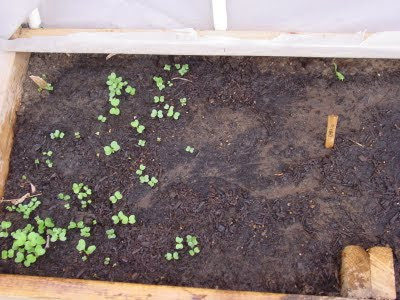
If you look closely, the chard seeds are starting to show as well.

I am still waiting for the cabbage. Stay tuned.

If you look closely, the chard seeds are starting to show as well.

I am still waiting for the cabbage. Stay tuned.
Wednesday, September 30, 2009
Cold Frame Construction
As the weather cools, I get rejuvenated about the garden. Currently I am swimming in melons and beets and carrots. But I know that soon enough the summer bounty will wane. I will quickly go from being selective of which fruits to pick to scrounging for something that isn't soft from frost. In recent years, I have tried to remember to plant cool weather seeds in August. This year I did remember and have a nice crop of lettuces already. The problem has always been finding space. So I started constructing raised beds that I can cover as it cools, or shade in the spring as it warms. These raised beds also help define the garden and don't get in the way of the larger summer plot, to which I add compost and rototill every fall and spring.
I convinced the bosses (not hard to do really) to let me build a cold frame at work as a sort of show bed. I told them I could convince people more easily to use our topsoil if they can see a pleasant little crop of radishes, beets, and greens. Besides, with what we promote and believe as a company, how can we NOT have a vegetable garden?! (Actually, we tried several years ago. We did it differently and got hammered by the rabbits, the wind and the sun.)
So I did build one. It really is very simple, it only took me a morning to do it all.
As always, I start at the trusty recycled lumber pile. Between what's available and what I have in mind, I can collect the necessary pieces.

Then, I construct the bed and place it. In this case, it is on a south facing wall. It will get plenty of shade from a beautiful Chitalpa in the summer, but when the tree drops its leaves, the bed will get a heavy dose of winter sun. Hopefully the building will trap some heat and protect the cold frame from some wind. Maybe we will even get a little heat from the radiant heater that sits inside the office.

Before I fill the frame with a high quality planting medium (read: Soilutions' Topsoil Blend; a mixture of our Premium Compost and local sandy loam that is approved for use on certified organic gardens in NM) I placed a wire mesh on the bottom. My intent is to keep squirrels, skunks, or gophers out of it. I used a piece of galvanized hardware cloth that we had sitting around the heap. Chicken wire would work well, too.

In goes the Topsoil Blend...

then the seeds.

I scavenged a couple of lengths of 3/4" PVC and some sheeting from our trash pile and put together a little hoop frame to cover the bed. This will act like a greenhouse: keep the moisture and the day's heat in and the frost out. 1/2" PVC would have worked better, i.e., more flexible, but when you using recycled materials, you take what you find.

If, during the day, it gets too warm, which is all too often this time of year, I can open the lid temporarily.

Stay tuned for progressive photos of the sprouts. Don't be bashful, come on down and grab a radish or two!
I convinced the bosses (not hard to do really) to let me build a cold frame at work as a sort of show bed. I told them I could convince people more easily to use our topsoil if they can see a pleasant little crop of radishes, beets, and greens. Besides, with what we promote and believe as a company, how can we NOT have a vegetable garden?! (Actually, we tried several years ago. We did it differently and got hammered by the rabbits, the wind and the sun.)
So I did build one. It really is very simple, it only took me a morning to do it all.
As always, I start at the trusty recycled lumber pile. Between what's available and what I have in mind, I can collect the necessary pieces.

Then, I construct the bed and place it. In this case, it is on a south facing wall. It will get plenty of shade from a beautiful Chitalpa in the summer, but when the tree drops its leaves, the bed will get a heavy dose of winter sun. Hopefully the building will trap some heat and protect the cold frame from some wind. Maybe we will even get a little heat from the radiant heater that sits inside the office.

Before I fill the frame with a high quality planting medium (read: Soilutions' Topsoil Blend; a mixture of our Premium Compost and local sandy loam that is approved for use on certified organic gardens in NM) I placed a wire mesh on the bottom. My intent is to keep squirrels, skunks, or gophers out of it. I used a piece of galvanized hardware cloth that we had sitting around the heap. Chicken wire would work well, too.

In goes the Topsoil Blend...

then the seeds.

I scavenged a couple of lengths of 3/4" PVC and some sheeting from our trash pile and put together a little hoop frame to cover the bed. This will act like a greenhouse: keep the moisture and the day's heat in and the frost out. 1/2" PVC would have worked better, i.e., more flexible, but when you using recycled materials, you take what you find.

If, during the day, it gets too warm, which is all too often this time of year, I can open the lid temporarily.

Stay tuned for progressive photos of the sprouts. Don't be bashful, come on down and grab a radish or two!
Saturday, September 26, 2009
Constructing a Worm Bin
Hopefully by now, many people are aware of the wonders of redworms. These little guys happily eat foodwaste (or any other organic waste) quickly without demanding much from us. Unlike humans, they only eat what won't kill them and they reproduce only as food and space allow. On top of that, the vermicompost they secrete is biotically dense and beneficial to soils and plants.
This weekend, I built a small worm bin for the compost site. The bins we already have here are on the north side of the office. This is to keep them as cool as possible in the summer. But in the winter, the poor critters freeze and become hard to harvest. So, after much cajoling from the bosses, we decided to put a smaller bin on the south of the office for winter time harvesting. (Let me clarify now that worms are productive year round, though they are more lethargic in weather extremes, i.e., winter and summer. Given the right environment they will manage your waste very efficiently all year.)
The first thing to do is choose a location for a worm bin. As I said, we chose a spot in the garden that would be sunny in the winter but shaded in the summer. We have also found that an in-ground system is the easiest and best insulated.
After we have agreed upon an appropriate location, I start by digging the hole.

The hole size depends solely on the available space and the anticipated volume of waste generated. I like to line the hole so that dirt doesn't fall back in. For the lining, I go to my trusty recycled limber pile and pull out what I'll need.

I also dig it deep enough so that the worms have room to move to an area to their liking. In this case, I dug it 14" deep to have plenty of room below the freeze line.

Once the hole is dug, and after I build the frame, I place the frame into the hole. I want the edges to be close to ground level.

Into the frame goes the worms generously donated by a neighbor, taken from another bin, or purchased from us (or Gardener's Guild in ABQ).

I then fill the remainder of the bin with yummy feedstocks. This material can be anything readily available. I used mouldy straw and horse manure.

Almost done!
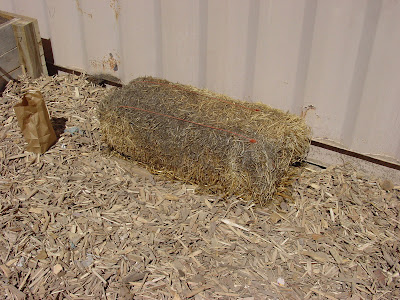
Since this is a bin constructed for winter harvesting, I put an extra layer of insulation, in this case an old straw bale. A little mulch to make it all attractive, and Voila, we have a worm bin.
This weekend, I built a small worm bin for the compost site. The bins we already have here are on the north side of the office. This is to keep them as cool as possible in the summer. But in the winter, the poor critters freeze and become hard to harvest. So, after much cajoling from the bosses, we decided to put a smaller bin on the south of the office for winter time harvesting. (Let me clarify now that worms are productive year round, though they are more lethargic in weather extremes, i.e., winter and summer. Given the right environment they will manage your waste very efficiently all year.)
The first thing to do is choose a location for a worm bin. As I said, we chose a spot in the garden that would be sunny in the winter but shaded in the summer. We have also found that an in-ground system is the easiest and best insulated.
After we have agreed upon an appropriate location, I start by digging the hole.

The hole size depends solely on the available space and the anticipated volume of waste generated. I like to line the hole so that dirt doesn't fall back in. For the lining, I go to my trusty recycled limber pile and pull out what I'll need.

I also dig it deep enough so that the worms have room to move to an area to their liking. In this case, I dug it 14" deep to have plenty of room below the freeze line.

Once the hole is dug, and after I build the frame, I place the frame into the hole. I want the edges to be close to ground level.

Into the frame goes the worms generously donated by a neighbor, taken from another bin, or purchased from us (or Gardener's Guild in ABQ).

I then fill the remainder of the bin with yummy feedstocks. This material can be anything readily available. I used mouldy straw and horse manure.

Almost done!
Since this is a bin constructed for winter harvesting, I put an extra layer of insulation, in this case an old straw bale. A little mulch to make it all attractive, and Voila, we have a worm bin.

Saturday, September 19, 2009
Free Latillas

Here's a great pile of cedar wood. Get these while you can--they're sure to be ground up in a week or two.
I imagine they could be used for latillas, coyote fencing, fire wood, furniture....
Thursday, September 17, 2009
Rainy Days Ramblings

I spend so much time hoping for rain that I get a little shocked when we actually get a couple of days of good soft rain. I know I can count on at least one good down pour during state fair time (I don't know why that is) and really look forward to it; it's usually still hot.
This year,though, the rain is providing me an added service: offering time to reflect. So often, we get the monsoons--moisture that builds most of the day, lurking on the horizon. We hustle about to finish up jobs or errands before the torrents force us inside for an hour. The monsoons actually add frenzy to my life. But today, as I sit in the tin box office, listening to the rain pop like corn on the roof, I have to bide my time. Not much will happen today--no customers, no sales, too sloppy to run the tractors in the yard.
Rains like this remind me of home. Long winter days and nights of moisture. I laugh to myself when I recall how we used to curse the moisture that would mould our towels, render newspapers unreadable, drip through the rafters, chills us through to the bone after weeks of trying to battle it. It would affect our soccer practices, our shopping routines, our dress code. Yet it would also bring the snails out for which my dad gave me .25$ per full milk jug. I would love the foam and sizzle produced from the 1/2 cup of salt we layered into the jugs to kill them; a sort of snail melba. Or my dad would get up on the flat roof and clean the oak leaves from the downspouts. If I wasn't careful below, I could get a good dollop of wet leaves across my shoulders as he'd throw them down. I learned to monitor his whereabouts by keeping track of his tobacco pipe or cigar smoke mixing with the wet air, swirling like a little chimney from roof-corner to roof-corner. Sometimes we would traipse the half-block to the park to watch the creek rise from a dribble to a stream to a torrent. There was a sense of danger standing on the bank that as a child I didn't quite understand but relished nonetheless. I guess I felt proud to be old enough to be trusted with peril.
When I lived in town not too long ago, the boys and I would rush outside to splash in the gutters or to watch elm leaves race each other down the block. I know that the neighbors were watching us and feeling that happiness people feel when watching youngster's pure joy.
Nowadays it seems that when it rains, I have to just stop. Just stand by the door and watch the rain fall into puddles. I try to think of words to describe the sound or feel of it. What else does that little plop resemble? If I were talented, then that little plop would resemble a deep breathe. And in that river of warm air as it exits my body would be my bills, my attitude, my sore muscles, my chores, errands, and obligations. My parents would be young again, and my wife happy. My spirit, anxious to be cleansed, would float on that deep breathe like a leaf in the gutter, and dance between each rain drop. Or it would raise it's weary head and catch just one on it's tongue.
For me this is time well spent.
Friday, September 11, 2009
Master Composter Classes Now Available
Through the hard work and perseverance of John Zarola, Albuquerque will be able to offer Master Composter classes in the spring. The classes will be designed to "teach the teachers." This means that interested individuals will be able learn all about small scale backyard composting in such a way that they will then go out into their community, i.e., neighborhood associations, schools, senior centers, and instruct others.
The training classes, for approximately 20 students, are projected to be held on:
April 24, 25 and May 1, 2 of 2010. Classes will run from 9 AM - 3 PM on all 4 days.
Class location will be: the Open Space Visitors Center, 6500 Coors Blvd., NW, ABQ, 87103.
Jim Brooks (of Soilutions fame) and other professionals will instruct the students according to the stated curriculum. Field trips will be added to the training requirements as planning evolves.
Students accepted into the program will agree to a certain number of volunteer hours which will be completed after graduation by teaching the interested public about home composting.
The current active steering committee is composed of: Jim Brooks, DeLaina Cushing, Dorothy Koopmans, Joran Viers and John Zarola.
After construction of an informational website, continued information, including: curriculum, references, application form, text book and assignments will be available at:
www.bernalilloextension.nmsu.edu/mastercomposter. Notice will be sent when this site is active.
Currently questions of interest may be sent to: John Zarola, Volunteer Coordinator johnzarola@comcast.net.
505.929.0414
The training classes, for approximately 20 students, are projected to be held on:
April 24, 25 and May 1, 2 of 2010. Classes will run from 9 AM - 3 PM on all 4 days.
Class location will be: the Open Space Visitors Center, 6500 Coors Blvd., NW, ABQ, 87103.
Jim Brooks (of Soilutions fame) and other professionals will instruct the students according to the stated curriculum. Field trips will be added to the training requirements as planning evolves.
Students accepted into the program will agree to a certain number of volunteer hours which will be completed after graduation by teaching the interested public about home composting.
The current active steering committee is composed of: Jim Brooks, DeLaina Cushing, Dorothy Koopmans, Joran Viers and John Zarola.
After construction of an informational website, continued information, including: curriculum, references, application form, text book and assignments will be available at:
www.bernalilloextension.nmsu.edu/mastercomposter. Notice will be sent when this site is active.
Currently questions of interest may be sent to: John Zarola, Volunteer Coordinator johnzarola@comcast.net.
505.929.0414
Thursday, September 03, 2009
Question: What's your take on Permaculture?
Recently a friend of mine in San Francisco asked me about Permaculture. He'll be taking classes soon and wanted my take on it.
 Well, I have mixed feelings. I have never taken any formal Permaculture classes or instructions. I would say I am more of a follower of Jim Brooks than of Permaculture per se. Simply put, Permaculture promotes the idea of making any space – a yard, a home, a business, a community, etc. – into a self-contained system that supplies its own needs, creates abundance, and regenerates waste within itself. The above image depicts the ideology behind Permaculture very well: interdependence, fluidity, and the cyclical qualities of nature, of which we are a part. To me the rising popularity of the term Permaculture is due to urbanites need to classify a lost way of life. Like the "green" movement, "sustainability", and "local", Permaculture has been usurped by larger powers as a way to make sense of people's reactions to the chaos they find themselves living in. It irks me that there are websites now stating "Have a Permaculture Business" and even "Let Permaculture Design Your Kitchen." Permaculture is by far a better idea than the general mindless living we have fallen into, but in no way the sole solution. There are just too many threads running through our lives to successfully adhere to one ideology.
As a part of larger living philosophy, though, Permaculture is certainly helpful.
I have gleaned from various conversations and readings that Permaculture is a practice of sensible, logical, and thoughtful living through management of resources on available property. Instead of building a fence by driving to a box store and buying harvested rain forest wood, Permaculture suggests that we build what we in the southwest call a coyote fence out of limbs and branches from our property. Or better still, plant a living fence, maybe out of berry bushes so that we have two (or more) functions in one feature: barrier, wildlife habitat, and food source. In the southwest, water is a big issue in Permaculture circles. Again, Permaculture guides us to use our brain. Most standard building codes mandate that water be whisked away from a dwelling as quickly as possible. These houses usually have underground automated sprinkler system, too. The Permaculturist asks why pump water out of the aquifer to water a lawn when we can harvest the rain or grey water to perform the same function? And why do we have a lawn that needs to be watered in the first place?
Brad Lancaster in his indispensable book "Rainwater Harvesting for Drylands and Beyond, Vol. 1" makes the suggestion that in order to properly manage water on a property, we need to watch it first to learn how it flows. Yet how often do we run inside out of the rain? Simple logic like this goes against our inclinations, but I don't think it goes against our intuitions.
Like most things, we do not NEED to study Permaculture to practice it. Simply slowing down, being mindful of our surroundings, and being thoughtful in our approach to a problem or project is all that we need to do to be a successful Permaculturist.
 Well, I have mixed feelings. I have never taken any formal Permaculture classes or instructions. I would say I am more of a follower of Jim Brooks than of Permaculture per se. Simply put, Permaculture promotes the idea of making any space – a yard, a home, a business, a community, etc. – into a self-contained system that supplies its own needs, creates abundance, and regenerates waste within itself. The above image depicts the ideology behind Permaculture very well: interdependence, fluidity, and the cyclical qualities of nature, of which we are a part. To me the rising popularity of the term Permaculture is due to urbanites need to classify a lost way of life. Like the "green" movement, "sustainability", and "local", Permaculture has been usurped by larger powers as a way to make sense of people's reactions to the chaos they find themselves living in. It irks me that there are websites now stating "Have a Permaculture Business" and even "Let Permaculture Design Your Kitchen." Permaculture is by far a better idea than the general mindless living we have fallen into, but in no way the sole solution. There are just too many threads running through our lives to successfully adhere to one ideology.
As a part of larger living philosophy, though, Permaculture is certainly helpful.
I have gleaned from various conversations and readings that Permaculture is a practice of sensible, logical, and thoughtful living through management of resources on available property. Instead of building a fence by driving to a box store and buying harvested rain forest wood, Permaculture suggests that we build what we in the southwest call a coyote fence out of limbs and branches from our property. Or better still, plant a living fence, maybe out of berry bushes so that we have two (or more) functions in one feature: barrier, wildlife habitat, and food source. In the southwest, water is a big issue in Permaculture circles. Again, Permaculture guides us to use our brain. Most standard building codes mandate that water be whisked away from a dwelling as quickly as possible. These houses usually have underground automated sprinkler system, too. The Permaculturist asks why pump water out of the aquifer to water a lawn when we can harvest the rain or grey water to perform the same function? And why do we have a lawn that needs to be watered in the first place?
Brad Lancaster in his indispensable book "Rainwater Harvesting for Drylands and Beyond, Vol. 1" makes the suggestion that in order to properly manage water on a property, we need to watch it first to learn how it flows. Yet how often do we run inside out of the rain? Simple logic like this goes against our inclinations, but I don't think it goes against our intuitions.
Like most things, we do not NEED to study Permaculture to practice it. Simply slowing down, being mindful of our surroundings, and being thoughtful in our approach to a problem or project is all that we need to do to be a successful Permaculturist.
Wednesday, September 02, 2009
Recycling in New Mexico
It's difficult being in the recycling business in New Mexico. We often feel 30 years behind everyone else. We hear of $70-150 landfill tip fees on the coasts; ours is $3.85/cubic yard residential. California has goals to reduce waste going to landfills by %75 by 2010 but we as a state have a 12% recycling rate. We read of innovative uses for carpet, tires, glass in other parts of the country while it seems the only use in New Mexico for these types of materials is to line the sides of roads and ditches. There IS a lot of local enthusiasm for the "green movement", for recycling, etc. just not a lot of will shown by our lawmakers.
However, in the latest issue of BioCycle, there is an article about a yard waste recycling and composting facility in Kansas City, Missouri. I have roots in KC going back all of my 42 years and then some. One thing that always startled me on visits to the area was a skepticism toward recycling. I have a cousin who actually asked me "why should I recycle." When an Uncle from the area heard I was in this business, he turned me on to Missouri Organic Recycling (MOR); his friend started it years ago with his dad, or some such. Last time I was out there, I dragged my parents out to their (MOR) facility. I might just be the only person who visits dumps on their vacation. Anyway, I haven't felt so at home. With the exception of standing water, the facility looks very similar to ours.
Now back to the article in BioCyle. On the cover is a picture of food waste that looks very similar to large loads of food waste we get here on a regular basis. When I opened the magazine to the article, sure enough, MOR was the featured facility. Change the name from MOR to Soilutions, and ignore all the stuff about the state and all sorts of agencies throwing money at them from both sides to get the food waste collection program running,the article could be about Soilutions. They have the same challenges, the same goals, the same successes. MOR is just 10 years ahead of Soilutions.
So it gives me hope to see that we at Soilutions are developing innovative programs that, while they may not be avant-garde in relation to the rest of the world, they are on the right track to be on a par with the heavy hitting composters of the country.
However, in the latest issue of BioCycle, there is an article about a yard waste recycling and composting facility in Kansas City, Missouri. I have roots in KC going back all of my 42 years and then some. One thing that always startled me on visits to the area was a skepticism toward recycling. I have a cousin who actually asked me "why should I recycle." When an Uncle from the area heard I was in this business, he turned me on to Missouri Organic Recycling (MOR); his friend started it years ago with his dad, or some such. Last time I was out there, I dragged my parents out to their (MOR) facility. I might just be the only person who visits dumps on their vacation. Anyway, I haven't felt so at home. With the exception of standing water, the facility looks very similar to ours.
Now back to the article in BioCyle. On the cover is a picture of food waste that looks very similar to large loads of food waste we get here on a regular basis. When I opened the magazine to the article, sure enough, MOR was the featured facility. Change the name from MOR to Soilutions, and ignore all the stuff about the state and all sorts of agencies throwing money at them from both sides to get the food waste collection program running,the article could be about Soilutions. They have the same challenges, the same goals, the same successes. MOR is just 10 years ahead of Soilutions.
So it gives me hope to see that we at Soilutions are developing innovative programs that, while they may not be avant-garde in relation to the rest of the world, they are on the right track to be on a par with the heavy hitting composters of the country.
Subscribe to:
Posts (Atom)